
In the world of industrial machinery, Helical Gearboxes are the silent workhorses driving everything from conveyor belts to heavy-duty mixers. Their efficiency and longevity hinge on one critical question: What lubrication is recommended for helical gearboxes? The wrong choice can trigger overheating, destructive pitting, and sudden breakdowns—costing thousands in lost production. Yet the right lubricant, tailored to load, speed, and temperature, transforms performance, minimizing wear and energy loss. Many procurement professionals and maintenance teams overlook the subtleties of gearbox oil selection, from base oil type to additive chemistry. Drawing on over two decades of transmission engineering experience, Raydafon Technology Group Co.,Limited has helped hundreds of clients turn lubrication science into a competitive advantage. This guide will walk you through the pain points, expert solutions, and data-driven parameters you need to protect your assets and streamline purchasing decisions. Read on to master the lubrication strategy that keeps your operation running like a Swiss watch.
Helical gearboxes transfer torque through angled teeth that engage gradually, creating both rolling and sliding friction. This distinctive mesh action generates heat and requires a lubricant film strong enough to separate metal surfaces under extreme pressure. Without adequate lubrication, the tooth flanks suffer microwelding, scuffing, and eventually macro-pitting. The lubricant must also dissipate heat, flush away wear debris, and protect against corrosion. For procurement teams, specifying the wrong lubricant at the assembly stage can void warranties and inflate total cost of ownership. The question “What lubrication is recommended for helical gearboxes?” thus goes beyond a simple fluid pick—it’s about matching the lubricant’s rheological and chemical profile to the operating duty cycle. A well-designed lubrication program reduces energy consumption by up to 15%, according to field studies, while extending oil drain intervals. Understanding these requirements upfront positions you to negotiate better with suppliers and avoid rushed, ill-informed decisions later.
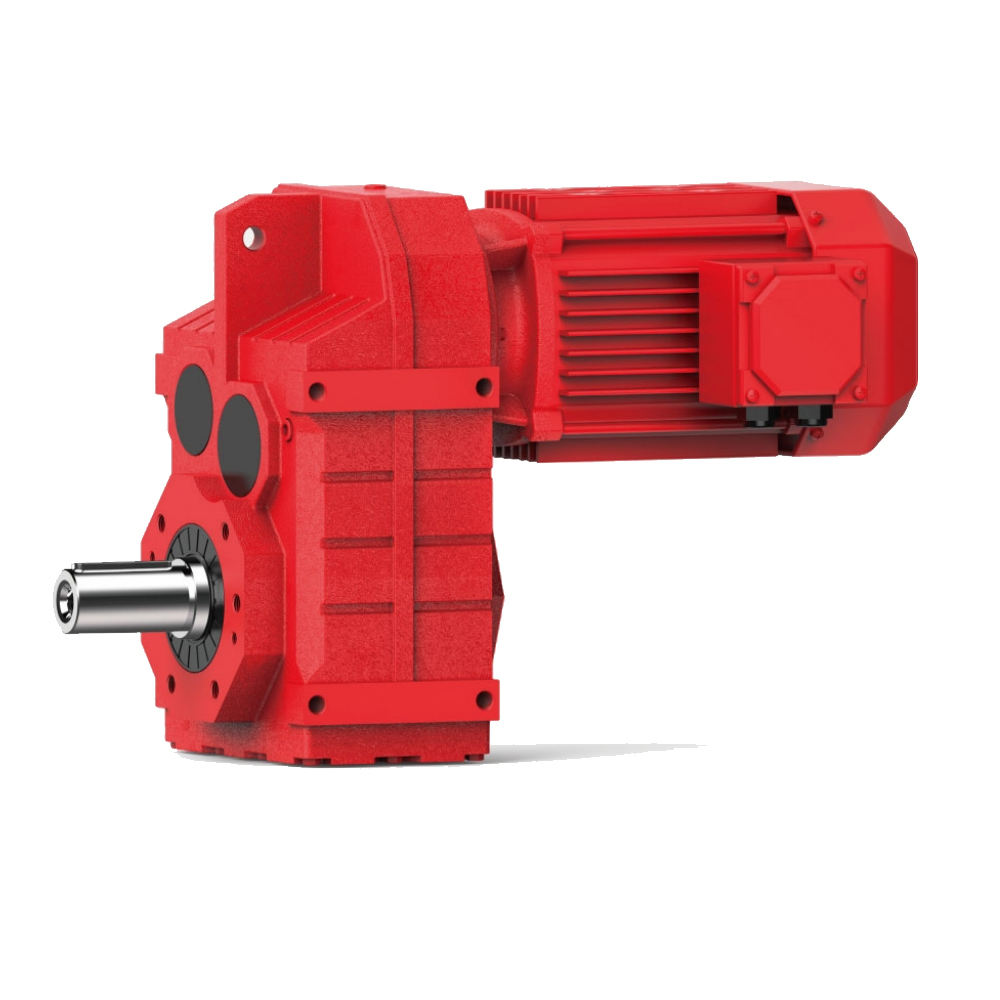
Pain point scenario: A packaging plant runs a helical gearbox 24/7. Six months after a low-bid lubricant fill, the gearbox begins emitting a high-pitched whine and running 20°C hotter than normal. Vibration analysis reveals early-stage tooth spalling. The culprit? An inferior mineral oil that sheared down in viscosity under sustained load, failing to maintain a protective elastohydrodynamic film. The result: $12,000 in emergency replacement parts and two days of halted production.
Solution: Transition to a polyalphaolefin (PAO)-based synthetic gear oil with an extreme-pressure (EP) additive package designed for helical gears. Ensure the oil meets DIN 51517-3 or AGMA 9005-E02 standards. Pair this with regular ferrography testing to catch wear metals before damage escalates. The following table contrasts the failure-prone lubricant and the recommended alternative.
| Parameter | Failed Mineral Oil | Optimized PAO Gear Oil |
|---|---|---|
| Viscosity Index | 95 – 105 | ≥150 |
| Flash Point (°C) | 210 | 250+ |
| Pour Point (°C) | -15 | -40 |
| FZG Scuffing Load Stage | 9 – 10 | ≥12 |
| Oxidation Stability (RBOT, min) | 200 | 800+ |
Procurement specialists often wonder, “What lubrication is recommended for helical gearboxes when ambient extremes or contamination risk come into play?” The answer lies in matching base oil chemistry to the environment. Mineral oils offer a cost-effective solution for mild, clean conditions with moderate temperature swings. Semi-synthetic blends strike a balance between performance and budget. Full synthetic options—PAOs, esters, or polyglycols—excel in severe-duty cycles, high temperatures, and applications demanding long service life. Polyglycols, in particular, stand out for their ability to absorb water without losing protection, making them ideal for food processing or high-humidity settings. The decision tree below helps clarify the selection based on real-world conditions.
| Operating Condition | Recommended Base Oil | Raydafon Support |
|---|---|---|
| Moderate load, <60°C, clean | High-quality mineral oil | Pre-curated supplier list |
| Wide temperature swings | PAO synthetic | Viscosity modeling tool |
| High water exposure | Polyglycol | OEM compatibility check |
| Food-grade requirement | NSF H1 ester/PAO | Compliance documentation |
| Extreme shock loads | EP synthetic gear oil | Custom oil analysis program |
Viscosity is the single most influential property when determining what lubrication is recommended for helical gearboxes. Operating at the wrong ISO viscosity grade can accelerate wear as dramatically as using no oil at all. For most industrial helical gearboxes, ISO VG 150 to VG 460 covers the spectrum, but load speed factor (KS/V) and pitch line velocity dictate the precise grade. Additive chemistry then fine-tunes performance: EP additives form sacrificial layers on gear teeth to prevent welding, rust inhibitors protect against moisture, and antifoam agents maintain oil film integrity. Insufficient additive treat rate leads to micropitting; excessive additive ash can block filters. Balancing these factors requires data-driven decision making, which Raydafon Technology Group Co.,Limited supports through on-site lubricant audits.
| Application | ISO Viscosity Grade | Critical Additive | Typical Treat Rate |
|---|---|---|---|
| Low-speed, high-load (>0.8 KS/V) | VG 320 – 460 | Sulphur-phosphorus EP | 1.5–3.0% |
| Medium-speed conveyor | VG 150 – 220 | Zinc dialkyldithiophosphate (ZDDP) | 0.8–1.2% |
| High-speed, low-load | VG 68 – 100 | Antioxidant + antifoam | 0.5% |
| Cold climate startup | VG 68 – 150 synthetic | Pour point depressant | 0.3–0.8% |
Even the finest lubricant underperforms if applied incorrectly. A common scene: maintenance teams top up oil without checking contamination levels, mixing incompatible chemistries, or ignoring breather vent condition. Over time, particle ingress scores journals and bearings, mimicking lubrication starvation. Best practices begin with a lubrication management system that tracks oil type, fill date, and service hours for every gearbox. Regular oil analysis—viscosity, water content, particle count, and elemental spectroscopy—spots problems before they cascade. Filtration to β3 ≥ 200 (ISO 4406 cleanliness code 17/15/12 or better) is non-negotiable for high-reliability environments. When in doubt about what lubrication is recommended for helical gearboxes during extreme duty shifts, always consult the gearbox OEM or a specialist partner like Raydafon Technology Group Co.,Limited, who can interpret trending data and recommend condition-based maintenance intervals.
Raydafon Technology Group Co.,Limited doesn’t just supply transmission components; we engineer reliability into every power train. Our approach to answering “What lubrication is recommended for helical gearboxes?” starts with a thorough operational audit—mapping load spectra, thermal imaging gearboxes in situ, and sampling existing oil. We then pair global lubricant formulations with our own helical gearboxes and drive systems, ensuring chemical compatibility with seal materials, paints, and bearing cages. Clients receive a detailed specification sheet, complete with viscosity maps across their temperature range, drain interval projections, and cost-per-hour comparisons. This level of granular support transforms procurement from a cost center into a reliability profit center. Whether you’re commissioning a single gearbox or standardizing across multiple plants, Raydafon’s lubrication expertise closes the loop on total asset care.
For high-moisture exposure, polyglycol-based gear oils are strongly recommended due to their excellent hydrolytic stability and ability to absorb water without forming corrosive emulsions. In many cases, an ISO VG 220 or 320 polyglycol with rust and oxidation inhibitors will maintain film strength even with 1–2% water content. Raydafon Technology Group Co.,Limited offers a curated selection of these advanced lubricants and can assist with flushing procedures to safely transition from a standard mineral oil.
High-efficiency synthetic gear oils with a low traction coefficient, such as certain PAO or ester-based fluids, cut churning and sliding losses by 3 – 8%. Look for ISO VG 68 to 150 grades with friction-modifier additives that still meet FZG stage 12 without slipping. Combined with optimized fill levels and smooth-running helical gearboxes from Raydafon, these lubricants can deliver a measurable drop in energy consumption, directly benefiting your operational expenditure.
Answering “What lubrication is recommended for helical gearboxes?” demands more than a label on a drum—it requires a holistic view of operating conditions, maintenance culture, and life-cycle costs. By applying the pain-point solutions, viscosity guidelines, and best practices outlined above, you position your procurement decisions for long-term success. We invite you to deepen your lubrication strategy with direct support from Raydafon Technology Group Co.,Limited. Whether you need a gearbox audit, a sample lubricant kit, or an expert second opinion, our team is ready to help you achieve smoother, more efficient operations.
Raydafon Technology Group Co.,Limited is a globally trusted provider of transmission solutions, including high-performance helical gearboxes, precision drive chains, and customized power transmission packages. Visit us at https://www.raydafon-chains.com or email our engineering team at [email protected] to discuss your next project or request a complimentary lubricant consultation.
Höhn, B.-R., Michaelis, K., & Doleschel, A. (2009). Frictional behaviour of synthetic gear lubricants. Tribology International, 42(9), 1371–1377.
Bartz, W. J. (2000). Lubricants and the environment. Tribology International, 33(3-4), 189–196.
Burrington, J. D., & Goodrum, J. W. (2015). Advances in extreme pressure additives for industrial gear oils. Journal of Synthetic Lubrication, 32(1), 15–24.
Mang, T., & Dresel, W. (2017). Lubricants and Lubrication, 3rd ed. Wiley-VCH.
Mitsis, C., & Geitner, F. K. (2018). Gearbox reliability improvement through condition-based oil analysis. Reliability Engineering & System Safety, 175, 78–86.
Poley, J. (2012). Oil Analysis: A Key to Equipment Reliability. Practicing Oil Analysis, 15(4), 22–28.
Scott, D., & Mills, G. H. (1983). Study of pitting failure in gears. Wear, 87(2), 141–152.
Sharma, B. K., & Stipanovic, A. J. (2003). Development of a new oxidation stability test method for lubricating oils. Thermochimica Acta, 402(1-2), 1–8.
Wang, Q. J., & Chung, Y.-W. (2013). Encyclopedia of Tribology. Springer.
Wren, F. J., & Totten, G. E. (2014). Gear lubricant formulations and additive technology. ASTM International, STP 1584.