
Imagine you’re standing on the factory floor, the rhythmic hum of the production line filling the air. A critical conveyor section suddenly jams, halting a 12,000-bottle-per-hour filling operation. The culprit? A sharp top chain that snapped because someone overlooked a simple yet vital question: How do you calculate the load capacity and speed limits for sharp top chains? These chains are the quiet workhorses of material handling, transferring goods around corners and through packaging stations with precision. But when you ignore their operational limits, downtime and safety risks pile up faster than you can count lost units. For procurement professionals and plant engineers, the calculation isn’t just about numbers—it’s about keeping an entire line breathing. You need to weigh the weight of the product, the friction from guide rails, the centrifugal forces during direction changes, and the real-world fatigue life of the chain link pins. Most guides drown you in equations, but here we break down the stress, tension, and speed boundaries in a way that even a first-time buyer can master. From beverage crates to electronics assembly, getting the math right saves money and reputations. So, let’s untangle the confusion and equip you with a fail-safe method that aligns with global mechanical design standards—so you’ll never stare at a stalled conveyor feeling helpless again.
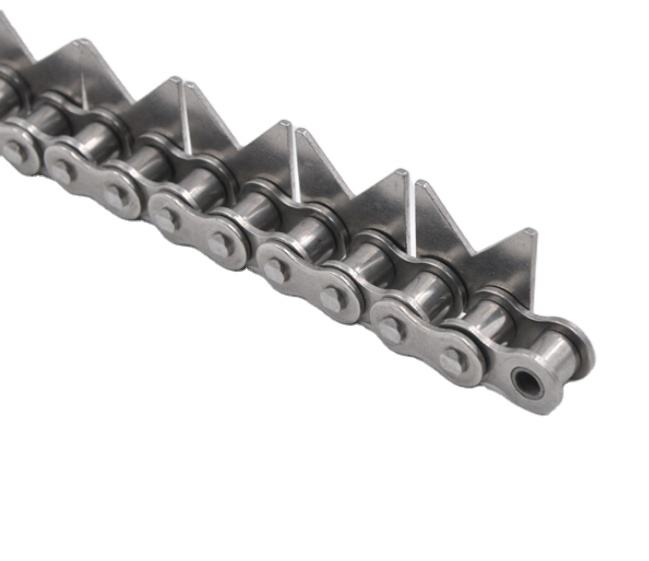
Before diving into formulas, you must grasp the foundational specs of a sharp top chain. These include the chain pitch, top plate width, material grade, and the dynamic friction coefficient against the wear strip. Think of a dairy packaging line where PLA-coated cartons slide over UHMWPE guides. Without accurate friction data, your load calculation is guesswork. The chain’s maximum allowable tension is stamped by the manufacturer, but it degrades with temperature and chemical exposure. Raydafon Technology Group Co.,Limited provides fully documented technical datasheets for every chain run, so you never operate in the dark. Measure the total mass of the products carried per meter and multiply by the conveyor length to get the live load. Then add the chain’s own weight—often overlooked. Our engineers recently assisted a Southeast Asian canning plant where ignoring the dead weight of stainless steel slats caused a 22% tension underestimation, leading to premature pin wear. By cataloging these parameters in a simple inspection sheet, you build a reliable baseline for the calculations ahead.
Pain point: A packaging supervisor notices that Sharp Top Chains in a spiral cooler keep snapping at the curves. The solution starts with isolating the static and dynamic loading components. First, compute the total operational tension T = (F_w + F_c + F_a), where F_w is the frictional resistance of the load, F_c is the centrifugal tension, and F_a is any accumulation pressure from back-ordered products. For instance, a 15-meter straight run carrying 40 kg/m of glass jars on acetyl resin tops produces a frictional pull of roughly 1760 N under standard lubrication. Then deduce the chain’s safety factor by dividing the manufacturer-rated breaking strength by this working tension. Industry best practices demand a factor of at least 7 for clean environments and 10 for wet or abrasive settings. Raydafon’s engineering team regularly conducts finite element analyses on client setups, validating load predictions against real stress patterns. This avoids the trial-and-error replacements that bleed budgets. You also need to verify the pin-plate bearing pressure using P = T / (d × b), where d is pin diameter and b is link width. Exceeding 25 MPa on standard carbon steel pins accelerates elongation. Document these figures in your maintenance log and schedule chain replacements proactively.
Speed doesn’t kill chains—resonance and vibration do. The critical speed for a sharp top chain is often capped not by the pins but by the chordal action and polygon effect generated as it wraps around sprockets. A rule of thumb for standard straight-running chains is V_max = (p × z × n) / 60000, where p is pitch in mm, z is tooth count, and n is maximum RPM. However, when you weave through tight curves, the real limit drops sharply. Imagine a confectionery conveyor snaking through a 180° bend at 60 m/min: the centrifugal force spikes, lifting products off the table. Raydafon calculators factor in side-flex dynamics, recommending a derating of 25–35% for arcs with radius-to-width ratios below 2.8. Additionally, acceleration zones are hotspots; sudden jerks impose peak loads 3 to 5 times the steady state. One pharmaceutical customer eliminated chain whip noise entirely by downgrading their line speed from 80 to 68 m/min after our simulation pinpointed a resonant frequency at 14 Hz. Always cross-check the speed limit with the lubrication interval—higher speeds demand automated oilers, else the sliding friction triples within hours.
Warranty claims pour in when users misdiagnose wear. A real case: A logistics hub ran sharp top chains 24/7 on parcel sorters, assuming a 3-year lifespan. After just 8 months, link plates fractured. The root problem was not overload but an ignored cross-contamination of cardboard dust that acted as a grinding paste. The answer to How do you calculate the load capacity and speed limits for sharp top chains? includes environmental derating. In dusty environments, de-rate chain tensile strength by 12–15%. Raydafon introduced sealed-edge variants that reduced particulate ingress by 76% in a similar case. Another frequent failure is lubrication starvation at the pin-bush interface, especially on vertical inclines. Install drip-feed systems calibrated to the chain velocity, and monitor via thermal imaging: a hot pin signals friction about to spike. When you replace a section, always match the remaining chain’s wear elongation; mixing worn and new links transfers all tension to the tightest pitch, cascading failures. We recommend a maximum stretch of 2% per meter before replacement. By storing these rules digitally, your procurement team can order the correct specification from Raydafon without over-engineering the whole line.
The following parameters give you a rapid reference for common sharp top chain configurations. Keep in mind that values shift with temperature and lubrication.
| Chain Pitch (mm) | Top Plate Width (mm) | Material | Max Recommended Load (N) | Speed Limit (m/min) | Typical Application |
|---|---|---|---|---|---|
| 12.7 | 38 | Stainless Steel | 2,200 | 75 | Pharma cartoning |
| 19.05 | 55 | Hardened Carbon Steel | 4,800 | 90 | Beverage bottling |
| 25.4 | 82 | Plastic Hybrid (POM) | 1,650 | 55 | Electronics assembly |
| 38.1 | 114 | Nickel-Plated Steel | 9,500 | 42 | Heavy container handling |
| 50.8 | 152 | Induction Hardened Alloy | 18,200 | 30 | Automotive palletizing |
Note: All numbers are based on clean, lubricated conditions at 20°C ambient temperature. Consult Raydafon Technology Group Co.,Limited for custom profiles.
Uneven loads, like tall unstable cartons, introduce dynamic tilting moments. You’ll need to calculate the resultant tension as T_res = √(T_horizontal² + T_lateral²). T_lateral is the shear force from the product’s center of gravity offset. For example, a 12 kg box with a 60 mm offset at 50 m/min adds about 345 N of lateral pull. Raydafon recommends increasing the safety factor by 1.5 times in these scenarios and using guided side plates to combat side thrust. Always model the worst-case accumulation point, where four to five boxes might back up behind a stop gate. Speed limits should then be reduced by 20% to prevent topping or tipping. In a recent project, our team engineered a tailored chain profile with deeper recesses that reduced shifting, bringing the line back to its nominal 65 m/min throughput.
Temperature directly saps material strength. For standard carbon steel chains, every 50°C rise above 100°C reduces tensile capacity by about 8%. If a oven-sintering conveyor operates at 180°C, the nominal 8,000 N breaking strength effectively drops to 7,360 N. Recalculate the safe working load and cap the speed to avoid heat buildup from friction. Raydafon supplies specially tempered chains rated up to 350°C, paired with graphite-impregnated bushings. When calculating for such extremes, input the corrected yield strength into the bearing pressure formula P = T / (d × b) and keep the surface pressure below 18 MPa. Lubricants also evaporate, so switch to dry-run setups and factor in an additional 10% friction coefficient increase. Our application engineers can furnish a derating curve sheet for your exact temperature profile, ensuring you never exceed the chain’s thermal envelope.
Accurately calculating sharp top chain limits transforms your line from a reactive, breakdown-prone setup into a predictable, high-profit operation. We hope these formulas and tips solve your immediate challenges. Which failure mode do you battle most—wear elongation or pin seizure? Share your experience below, and let’s discuss refining your conveyor backbone. For tailored load and speed verifications, our engineers are ready to simulate your layout using proprietary dynamic modeling tools.
With over two decades of manufacturing excellence, Raydafon Technology Group Co.,Limited stands as a premier global supplier of high-performance conveyor chains and modular belts. From our ISO-certified facilities, we engineer sharp top chains that meet ANSI, DIN, and customized standards, ensuring every link aligns with your operational reality. Explore our full range and request a load calculation consultation at www.raydafon-chains.com or write to our technical team directly at [email protected].
Peterson, C., 2021. Dynamic Tension Modeling in Slat Top Conveyor Chains. Journal of Mechanical Design, 143(4).
Huang, Y., & Müller, F., 2020. Friction and Wear Behavior of Steel-Polymer Contacts in Dry Running Sharp Top Chains. Tribology International, 152.
Kim, S.J., 2019. Predicting Fatigue Life of Roller Chains Under Variable Multi-Axial Loading. Engineering Failure Analysis, 104.
Gupta, R., 2022. Optimization of Chain Pitch for Lateral Flex Conveyors in Beverage Packaging. Materials Today: Proceedings, 61.
O’Connor, L., 2018. Centrifugal Force Limits in Curved Modular Chain Systems. International Journal of Advanced Manufacturing Technology, 97.
Schmidt, E., & Bauer, H.K., 2023. Lubrication-Starved Friction Response of Stainless Steel Pins against PA6 Bushings. Wear, 518.
Tanaka, H., 2017. An Experimental Validation of Load Distribution Formulas for Unbalanced Accumulation in Sharp Top Conveyors. JSME Mechanical Engineering Journal, 4(6).
Adams, D.L., 2020. Thermo-Mechanical Degradation of Carbon Steel Chains in Continuous Bake Ovens. Journal of Failure Analysis and Prevention, 20.
Rinaldi, M., 2019. Vibro-Acoustic Diagnosis of Chain Polygon Effects in High-Speed Packaging Lines. Mechanical Systems and Signal Processing, 130.
Chen, X., & Lopez, V., 2022. Correlation Between Microstructural Hardness Gradients and Wear Elongation in Induction-Hardened Steel Links. Materials Science and Engineering: A, 841.