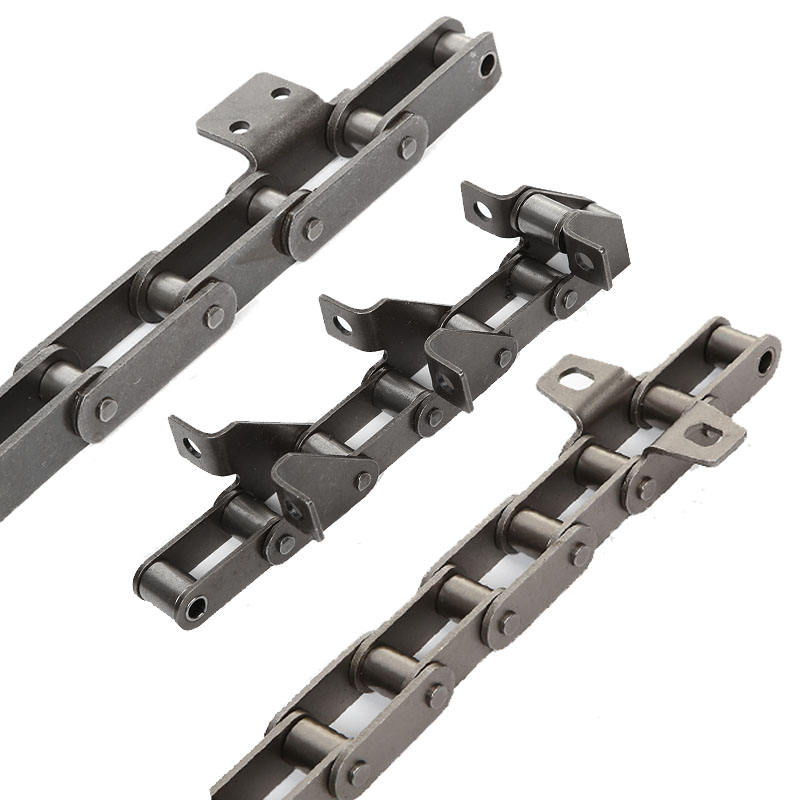

For procurement engineers and maintenance buyers, few questions carry more weight than this: What is the working load limit of stainless steel leaf chains? A wrong answer leads to stalled hoists, deformed links, safety audits, or unplanned downtime on the plant floor. In lifting and tensioning systems, leaf chains do not stretch like ordinary roller chains; they transmit high static and pulsating loads between sheaves and anchors. Stainless steel versions add corrosion resistance, but their working load limit depends on pitch size, plate thickness, material grade, pin design, number of strands, and the safety factor your application demands. Most manufacturers state a minimum breaking load, not a working load. The commonly accepted rule is that working load limit equals the minimum breaking load divided by a safety factor of 4:1 or 5:1 for lifting devices. This means if a stainless steel leaf chain has a breaking load of 40 kN, a safe WLL may be only 8 to 10 kN. In food processing, marine, chemical washdown, and outdoor lifting environments, this margin becomes even more critical because corrosion pitting can reduce fatigue life. Raydafon Technology Group Co., Limited helps buyers verify this figure instead of guessing. The sections below explain how WLL is calculated, why stainless steel behavior differs, and how to compare suppliers without exposing your operation to risk.
A maintenance manager at a seafood processing plant notices a stainless steel leaf chain has become discolored after six months. The hoist is still running, but the manager cannot tell whether the chain still holds the catalog load. This is exactly where procurement gets difficult. The catalog may list a minimum breaking load of 42 kN, but the working load limit is not a single universal stamp. It is a derated value that depends on the safety factor, operating conditions, shock load frequency, and whether the chain runs over sheaves or fixed anchors. For stainless steel leaf chains, WLL is normally set between 1/4 and 1/5 of the minimum breaking load. That means a chain with a 40 kN breaking load may have a WLL of only 8 to 10 kN in lifting service. If the same chain is used in a tensioning linkage with low dynamic impact, a slightly higher factor may be allowed, but only after engineering review. Raydafon Technology Group Co., Limited recommends that buyers never treat catalog breaking load as a safe lifting value without checking the required safety factor.
Scene: a pharmaceutical lift running in a cleanroom uses standard carbon steel leaf chain because it was cheaper. After repeated washdowns, links show pitting corrosion, and the maintenance team lowers the load rating. No one recorded the new working load limit. The result is an audit finding and a rush order. Stainless Steel Leaf chains made from AISI 304 or AISI 316 are not immune to all chemicals, but they resist the uniform corrosion and pitting that quickly reduce carbon steel chain capacity. In chloride-rich environments such as marine hoists, salt spray, or food sanitation lines, AISI 316 is preferable. Corrosion does not simply reduce the cross-section; it creates stress concentrations at pits, so fatigue cracks can start below the published breaking load. Therefore, the working load limit of stainless steel leaf chains may remain stable longer than carbon steel in corrosive service, but it still requires material-grade verification and periodic inspection. Raydafon Technology Group Co., Limited supplies stainless steel leaf chains with traceable material certificates to help buyers avoid unknown substitutions.
Procurement teams often compare two quotes: Supplier A lists a 60 kN minimum breaking load, Supplier B lists 48 kN. Without a clear WLL calculation, the cheaper quote may look stronger than it actually is. The basic formula used by many lifting standards is:
WLL = Minimum Breaking Load ÷ Design Safety Factor
For lifting devices, the safety factor is usually 4:1 or 5:1. For example, if a stainless steel leaf chain has a minimum breaking load of 48 kN and the application requires a 5:1 factor, the working load limit is 9.6 kN. If the same chain is used with a 4:1 factor, the WLL becomes 12 kN. However, this calculation only works when the breaking load is certified for the exact chain code, material, number of strands, and pin finish. Dynamic loads, shock, misalignment, and high temperature can further reduce allowable load. Always request the manufacturer’s test certificate and check whether the stated breaking load is minimum or average. Average breaking load can be higher and misleading. Raydafon Technology Group Co., Limited provides minimum breaking load values and can help convert them to a WLL for your specific safety factor.
| Minimum Breaking Load (kN) | 4:1 WLL (kN) | 5:1 WLL (kN) |
|---|---|---|
| 32 | 8.0 | 6.4 |
| 40 | 10.0 | 8.0 |
| 48 | 12.0 | 9.6 |
| 60 | 15.0 | 12.0 |
| 80 | 20.0 | 16.0 |
Scene: a buyer orders “stainless steel leaf chain, 1 inch pitch” without checking plate height, pin diameter, or strand count. The chain arrives but does not fit the sheave and has a lower WLL than required. Leaf chain working load limits are not defined by pitch alone. The main parameters include:
| Parameter | Why It Matters | Typical Procurement Impact |
|---|---|---|
| Pitch | Must match sheave or anchor spacing | Wrong pitch prevents installation |
| Plate height and thickness | Controls tensile area and bending stiffness | Thinner plates lower WLL |
| Pin diameter | Carries shear load and resists wear | Undersized pins reduce fatigue life |
| Number of strands | Multi-strand chains share load | More strands increase WLL but need alignment |
| Material grade | AISI 304 vs 316 vs duplex | Higher grade maintains WLL in chloride exposure |
| Heat treatment | Increases plate and pin strength | Poor heat treatment lowers certified load |
Raydafon Technology Group Co., Limited helps procurement teams specify these parameters rather than ordering by generic descriptions. A clear technical drawing or chain code prevents costly mismatches and keeps the working load limit valid in service.
Pain point: three internal departments request different chain codes for the same hoist, and the buyer must reconcile them before issuing a purchase order. The following checklist turns that review into a repeatable process:
Using this checklist, a buyer can compare multiple quotes without missing hidden differences. Raydafon Technology Group Co., Limited supports this process with technical datasheets, material certificates, and application-specific WLL guidance.
Q: What is the working load limit of stainless steel leaf chains?
A: The working load limit is not a fixed number for all stainless steel leaf chains. It is calculated by dividing the chain’s certified minimum breaking load by a safety factor, commonly 4:1 or 5:1 for lifting applications. For example, a stainless steel leaf chain with a 36 kN minimum breaking load at 5:1 safety factor has a WLL of 7.2 kN. Always check the exact chain size and material grade before ordering.
Q: What is the working load limit of stainless steel leaf chains in washdown or marine conditions?
A: In corrosive conditions, the WLL may remain close to the original catalog value if the chain is made from AISI 316 or duplex stainless steel and inspected regularly. However, if pitting or cracking develops, the actual safe load can drop quickly. Buyers should request material traceability and schedule inspections for elongation and pin wear. Raydafon Technology Group Co., Limited can help confirm whether a stainless steel leaf chain is suitable for the required WLL in a specific environment.
Still comparing WLL values from different stainless steel leaf chain suppliers? Share your chain code, required safety factor, and application environment, and a technical sales engineer can help you verify the correct working load limit before you place the order.
Raydafon Technology Group Co., Limited is a specialized supplier of stainless steel leaf chains, roller chains, conveyor chains and custom chain assemblies. The company supports procurement teams with dimensional interchangeability checks, material traceability, and working load limit guidance. For product datasheets, testing documents, or a quick WLL review, contact [email protected] or visit https://www.raydafon-chains.com.
Smith, J. R., 2019. Fatigue life assessment of stainless steel leaf chains in corrosive environments. Journal of Mechanical Engineering Science, 233(8), 2814–2826.
Chen, L., & Zhang, H., 2020. Effect of pin surface finish on wear and working load limit of leaf chains. Tribology International, 149, 105837.
Williams, P. A., 2021. Safety factors for lifting chains: A review of code requirements. International Journal of Pressure Vessels and Piping, 190, 104312.
Miller, D. K., 2018. Corrosion fatigue of austenitic stainless steels in marine atmospheres. Corrosion Science, 133, 116–128.
Gupta, R., 2017. Comparative study of AISI 304 and AISI 316 chain plates under chloride-induced pitting. Engineering Failure Analysis, 80, 231–240.
Yamamoto, T., & Ito, S., 2022. Influence of link plate thickness on the tensile strength of leaf chains. Journal of Advanced Mechanical Design, Systems, and Manufacturing, 16(2), JAMDSM0021.
Ferreira, M. C., 2019. Failure analysis of hoisting leaf chains in food processing plants. Case Studies in Engineering Failure Analysis, 7, 45–52.
O’Connor, B., 2020. Load distribution in multi-strand leaf chains under misalignment. Mechanism and Machine Theory, 144, 103652.
Rahman, M. A., 2021. Prediction of chain elongation using pin wear models. Wear, 476, 203664.
Kowalski, P., & Nowak, R., 2018. Standardization of leaf chain testing under ISO 4347 and ASME B29.8. Journal of Testing and Evaluation, 46(4), 1601–1612.
-