
As a procurement professional, you rarely buy a welded steel chain as a standalone item; you buy uptime, safety, and predictable maintenance. A single chain failure can stop a conveyor, drop a load, or trigger an investigation that costs far more than the chain itself. How Should You Choose the Right Welded Steel Chain for Your Application? The answer is not simply matching a part number or accepting the lowest quote. It starts with duty cycle, load profile, environment, attachment method, and the supplier's ability to document material, heat treatment, proof load, and dimensional consistency. In a typical scenario, three quotes arrive with similar photos but different pitch tolerances, plate thicknesses, and claimed working loads, leaving the buyer to compare apples with oranges. Raydafon Technology Group Co.,Limited helps buyers turn those ambiguous offers into comparable specifications. This guide gives you a practical sequence: define the application, match load ratings to the real duty cycle, verify material and manufacturing controls, design for wear and corrosion, and audit the supplier before you approve a sample, release a purchase order, or calculate total cost of ownership.
Painful scenario: a maintenance team replaces a worn welded steel chain with the same pitch and width, yet the new chain elongates within weeks. The root cause is often missing application data: shock loading, abrasive dust, poor lubrication, or a sprocket that no longer matches the chain. The catalog photo looked right, but the duty cycle was never defined.
Solution: build a one-page application brief before requesting quotations. Ask operations for load, speed, starts per hour, temperature, washdown, and attachment details. Send the brief with a drawing to every supplier so each quote addresses the same working conditions. This is also where Raydafon Technology Group Co.,Limited can help convert rough field notes into a clear chain specification.
| Input to define | Why it changes chain selection | What to send to the supplier |
|---|---|---|
| Load type and duty cycle | Steady, shock, reversing, or high-frequency loading changes the required safety margin and fatigue life. | Measured load, starts per hour, hours per day, and peak shock load. |
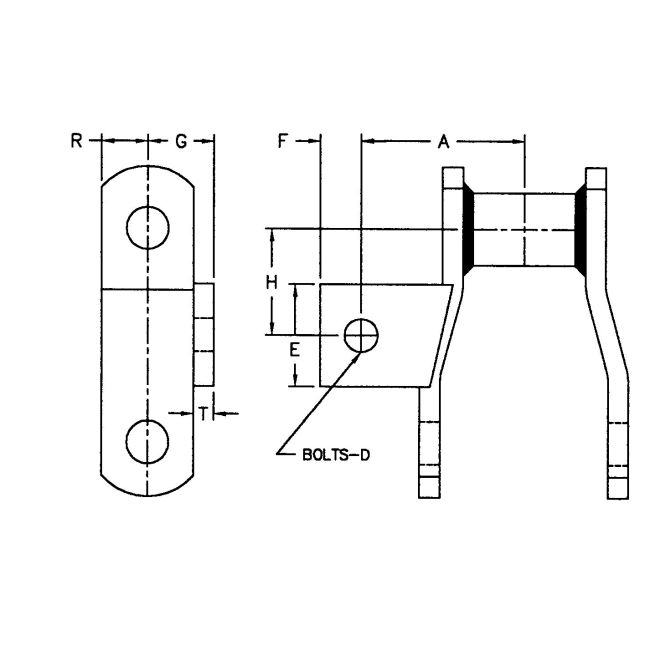
| Pitch and attachment space | Pitch, inner width, and attachment dimensions determine fit with sprockets, flights, and buckets. | Drawing with center distance, sprocket tooth count, and attachment hole pattern. |
| Environment | Abrasion, moisture, chemicals, and temperature drive material, coating, and lubrication choices. | Temperature range, humidity, dust, washdown, and chemical exposure. |
Painful scenario: one supplier quotes a working load, another quotes a breaking load, and a third mentions proof load without definition. The buyer compares three numbers that do not mean the same thing. A chain that looks stronger on paper may fail earlier in a shock-loaded conveyor because fatigue, not static strength, controls service life.
Solution: require every quotation to state the load basis, safety factor, and intended duty. Confirm whether the figure is working load, proof load, or breaking load. For lifting, towing, and high-shock conveying, ask for fatigue test data and reference installations. The table below gives buyers a simple comparison framework.
| Load term | What it means | Question to ask the supplier |
|---|---|---|
| Working load | The load a chain is rated to carry in normal service with the specified safety factor. | What safety factor is applied, and does it cover shock and fatigue? |
| Proof load | A test load used to verify integrity without permanent deformation under specified conditions. | Is proof load tested on every batch, and what acceptance limit is used? |
| Breaking load | The load at which the chain or a link fails in a tensile test. | Is breaking load based on full chain or link samples, and what test standard applies? |
| Fatigue limit | The repeated-load level a chain can endure without premature cracking under defined conditions. | Can you provide fatigue test data for a comparable duty cycle? |
Painful scenario: two Welded Steel Chains look identical in a photo, but one uses inconsistent wire grade, poor weld control, or uneven heat treatment. The buyer discovers the difference only after a shutdown, when link plates wear quickly, pins loosen, or pitch elongation exceeds the maintenance limit. Visual similarity is not a material specification.
Solution: request mill certificates, hardness results, weld inspection records, and dimensional reports with the sample. Check pitch, inner width, roller diameter where applicable, pin diameter, plate thickness, and weld flash. A supplier who can trace heat numbers and inspection lots is easier to audit and safer to approve. Raydafon Technology Group Co.,Limited supports buyers with documented material and dimensional verification so the approved sample matches the production order.
| Verification item | Why it matters | Evidence to request |
|---|---|---|
| Base material grade | Controls strength, ductility, and wear resistance. | Mill certificate with heat number and chemical composition. |
| Heat treatment | Affects hardness, toughness, and fatigue performance of links and pins. | Hardness report and process control record. |
| Weld quality | Poor welds create crack initiation points and inconsistent pitch. | Visual inspection, bend test, or agreed non-destructive check. |
| Dimensional consistency | Pitch and width errors cause sprocket wear, jumping, and vibration. | Measurement report for pitch, inner width, pin diameter, and plate thickness. |
Painful scenario: a chain performs well indoors, then fails early outdoors near washdown, salt air, or abrasive slurry. The buyer selected a standard welded steel chain because the load was moderate, but the environment changed the wear rate, corrosion rate, and lubrication interval. The lowest purchase price becomes the highest maintenance cost.
Solution: map the environment before choosing surface finish, lubricant, clearance, and attachment design. In abrasive dust, prioritize wear-resistant contact surfaces and reliable lubrication. In wet or chemical areas, consider corrosion protection and compatible lubricants. In high-temperature zones, confirm that the chain's tempering and lubricant can survive the heat. Use the table below to turn site conditions into specification questions.
| Environment | Typical risk | Specification response |
|---|---|---|
| Abrasive dust or grit | Accelerated pin, roller, and sprocket wear. | Specify wear-resistant material, sealed or controlled lubrication, and inspection intervals. |
| Moisture or washdown | Corrosion, lubricant washout, and seizure risk. | Choose suitable coating or material protection and confirm lubricant compatibility. |
| High temperature | Loss of hardness, lubricant breakdown, and thermal elongation. | Confirm allowable temperature, tempering range, clearance, and high-temperature lubricant. |
| Shock or reversing loads | Fatigue cracking and pin loosening. | Increase safety margin, verify fatigue data, and review attachment and sprocket alignment. |
Painful scenario: a purchase manager receives a low quote from a new chain supplier and a higher quote from an established one. The low quote omits inspection reports, packing protection, and lead-time buffers. Six months later, unplanned downtime and emergency freight erase the savings. The real comparison was never chain price versus chain price; it was total cost versus total cost.
Solution: score suppliers on specification clarity, sample verification, inspection evidence, production control, packing, lead time, and after-sales response. Ask for a pre-production sample and verify it against the same drawing used in the purchase order. Raydafon Technology Group Co.,Limited works with procurement teams to make these comparisons concrete, so buyers can approve a welded steel chain based on evidence rather than a catalog claim.
| Supplier criterion | Low-risk evidence | Red flag |
|---|---|---|
| Specification clarity | Written data sheet with load basis, dimensions, material, and standard. | Only a photo and a price are provided. |
| Sample verification | Measured sample report approved before mass production. | Sample differs from quotation or drawing. |
| Process control | Heat treatment, weld, and dimensional records available. | No traceability or inconsistent batch marks. |
| Delivery and packing | Protective packing, clear labels, and confirmed lead time. | Unclear shipping terms and no corrosion protection. |
Q1: When time is short, how should you choose the right welded steel chain for your application?
A1: Start with the three facts that cannot be guessed: measured load, duty cycle, and environment. Then request a written specification that states working load, proof load, breaking load, pitch, inner width, material, and inspection plan. Ask for a comparable reference installation. Raydafon Technology Group Co.,Limited can review your application brief and quote a welded steel chain configuration that matches those inputs, which reduces the risk of approving a chain based only on a catalog photo.
Q2: How should you choose the right welded steel chain for your application when the environment is abrasive?
A2: Treat abrasion as a wear-engineering problem, not a price problem. Confirm the dust or slurry condition, operating temperature, lubrication access, and maintenance interval. Specify material and surface conditions that resist wear, and ask for dimensional limits for pitch elongation so the maintenance team knows when to replace the chain. Compare suppliers on inspection evidence and total cost of ownership. Raydafon Technology Group Co.,Limited helps buyers document these requirements before the order is placed, so the chain selected for an abrasive line is supported by data rather than assumption.
Send your duty cycle, drawing, target service life, and inspection requirements to Raydafon Technology Group Co.,Limited, and our team will help you compare welded steel chain options against the real working conditions, not just the lowest quotation. Learn more at https://www.raydafon-chains.com, or contact [email protected] for specification review, sample verification, and supplier-side documentation. Raydafon Technology Group Co.,Limited supports procurement teams with practical chain selection, dimensional checks, and clear communication so every approved welded steel chain is easier to install, inspect, and maintain.
Zhang, Y., & Chen, L., 2021, Fatigue life prediction of welded steel chains under variable amplitude loading, Engineering Failure Analysis, 126.
Patel, R., & Kumar, S., 2019, Wear mechanisms in conveyor chains operating in abrasive environments, Wear, 426–427.
Müller, T., & Schmidt, J., 2020, Effect of heat treatment on the fatigue strength of welded chain links, Materials Science and Engineering: A, 793.
Garcia, M., Lopez, R., & Torres, J., 2018, Surface treatment and corrosion fatigue of welded steel chains in marine atmospheres, Corrosion Engineering, Science and Technology, 53(4).
Lee, H., & Park, J., 2022, Reliability-based design of welded steel chain systems for bulk material handling, Journal of Mechanical Science and Technology, 36(8).
Smith, A. J., & Brown, K., 2017, Inspection methods for chain links used in lifting applications, Insight – Non-Destructive Testing and Condition Monitoring, 59(6).
Wang, Q., Liu, H., & Zhao, M., 2020, Residual stress and fatigue performance of welded chain links after induction hardening, Materials & Design, 195.
Rossi, F., & Bianchi, M., 2019, Tribological behaviour of lubricated and unlubricated welded steel chains, Tribology International, 136.
Okafor, C., & Adeyemi, K., 2021, Failure analysis of welded steel chains in mining conveyors, Case Studies in Engineering Failure Analysis, 15.
Nakamura, S., & Tanaka, K., 2018, Load distribution in multi-strand welded chain drives, Mechanism and Machine Theory, 121.
-